IRCTC rules and regulations for agents: booking, counter and penalties
What IRCTC's own rules ask of every agent (RSP): how to take a booking, what never to do, what your counter must show and keep, and the penalty for each breach. Every rule below is linked to the clause it comes from.
The five things agents get fined for most easily
- No written request or ID copy: ₹5,000 + taxes per case. Keep both for six months.
- Wrong passenger mobile number: ₹5,000 + taxes per case.
- Booking on a personal IRCTC ID: the agent ID is deactivated immediately, with legal action.
- No sign board, certificate or money receipt: a warning the first time, permanent deactivation the second.
- Overcharging or holding back a refund: ₹20,000 + taxes plus double the amount, and permanent deactivation.
Who can be an IRCTC agent (RSP)?
Anyone registered with IRCTC through a Principal Service Provider who meets these registration rules. IRCTC's rules say ignorance of them "cannot be considered as a valid reason".
| Requirement | What IRCTC's rules say | Clause |
|---|---|---|
| Registration route | Registered with IRCTC by a Principal Service Provider (PSP). IRCTC issues the agent ID for booking e-tickets only. | A.I.i |
| Aadhaar | Aadhaar verification is mandatory at registration. | A.I.ii |
| PAN | PAN is mandatory for registration. | A.I.iii |
| Address, mobile, email | Correct address, a unique mobile number and a unique email ID. | A.I.vi |
| Login | An OTP is sent to the agent's registered mobile number at every login. A DSC is optional. | A.I.iv; 2020 policy VI.15 |
| Outlet | An internet connection and your own office with enough space for customers. | A.V.i |
| KYC | KYC of the agent is the PSP's responsibility. | A.V.ii |
| Address change | Tell IRCTC at once, with the original certificate issued by the PSP. | A.I.vii |
Ready to register? See IRCTC agent registration and the documents you need.
What must every booking have?
A written request, a correct mobile number, an invoice and the full list of charges. Miss one and the penalty is per case, so a busy counter can rack up several in a day.
| Condition | The rule | If not followed | Clause |
|---|---|---|---|
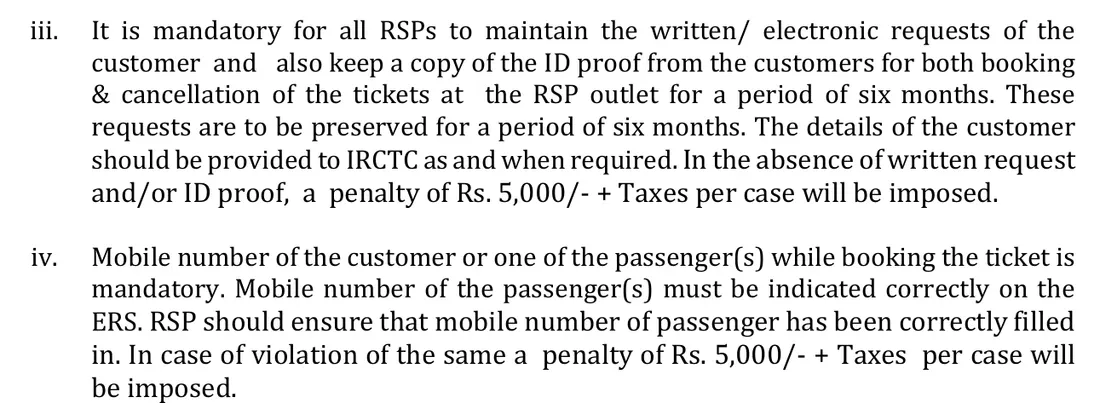
| Written request | Keep the customer's written or electronic request for every booking and cancellation, with a copy of the customer's ID proof, at the outlet for six months. | ₹5,000 + taxes per case | A.II.iii |
| Mobile number | Enter the correct mobile number of the customer or one of the passengers. It must show correctly on the ERS. | ₹5,000 + taxes per case | A.II.iv |
| Invoice | Issue an invoice on your own stationery for the amount collected. | No money receipt: minor irregularity (see penalties) | A.II.vi |
| Charges on the invoice | Show railway fare, IRCTC service charges, the agent's service charge (tax shown separately) and the payment gateway charge. | Overcharging: ₹20,000 + taxes + double the amount | A.II.vii |
| ERS | The Electronic Reservation Slip in IRCTC's format, with your name, full address and contact details and the PSP's name. | Tampering with the ERS is a criminal offence | A.II.v |
| Customer consent | Book only when the customer approaches you, with the customer's complete knowledge and acceptance. | Cancelling without the customer's knowledge: ₹20,000 + taxes | A.II.i–ii |
What can an agent charge the customer?
A fixed agent service charge per PNR, whatever the number of passengers, on bookings only. Nothing on cancellations.
| Charge | Sleeper | AC classes |
|---|---|---|
| Agent service charge, per PNR (GST included) | ₹20 | ₹40 |
| IRCTC service charge, per PNR | ₹15 + taxes | ₹30 + taxes |
| Cancellation | No agent service charge | |
Amounts from IRCTC's Norms for Internet Cafe Scheme, which says they are liable to change without notice. Payment gateway charges are shown separately on the invoice.
What must an IRCTC agent never do?
These are IRCTC's "Don'ts for Service Providers". Most of them lead to permanent deactivation of the agent ID.
-
Booking on a personal IRCTC user ID for commercial purposes.
Book only on the IRCTC-issued agent ID. The agent ID is deactivated immediately and punitive or legal action follows. Selling e-tickets booked on personal IDs is banned "in any manner, whatsoever".
Clause B.5, B.16 -
Sharing or transferring your agent ID or login.
Includes letting a third party or an e-commerce site sell through it.
Clause B.4 -
Overcharging, or any charge for cancellation or for checking availability.
There is no agent service charge on cancellations.
Clause A.II.viii, B.2 -
Benami tickets, fictitious names, or transfer and resale of tickets.
IRCTC's rules say resale is "punishable under Indian Railway Rules under Sec.142".
Clause B.6, B.11, B.12 -
Altering or tampering with the ERS.
Treated as a criminal activity, punishable under section 420 of the Indian Penal Code, as IRCTC's rules state.
Clause B.13 -
Tatkal robots, saved booking forms or any software tampering.
Also opening the Tatkal form early or during a banned period.
Clause B.14 -
Cancelling a ticket without the customer's knowledge and request.
Clause B.15 -
Selling I-tickets or counter tickets.
Minimum punishment is immediate deactivation.
Clause B.3 -
Print or press advertising, or using the IRCTC logo, without IRCTC's written approval.
No logo on visiting cards, letterheads or pamphlets, and no reservation forms with the IRCTC logo.
Clause B.1, B.7, B.9 -
Calling yourself an "authorised Railway Agent".
The correct description is "IRCTC authorized E-Ticketing agent".
Clause B.8

What must an IRCTC agent's counter show and keep?
IRCTC and your PSP run decoy checks on agent outlets. This is what they look for.
| Keep at the counter | What it means | Source |
|---|---|---|
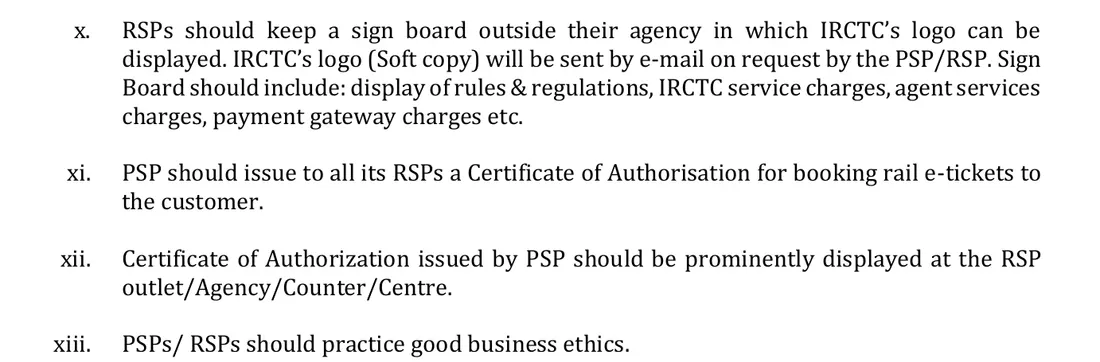
| Sign board | Outside the agency, showing IRCTC rules and regulations, IRCTC service charges, agent service charges and payment gateway charges. The IRCTC logo may be shown; the PSP or RSP can request the soft copy. | A.I.x |
| Display certificate | The Certificate of Authorisation issued by your PSP, prominently displayed at the outlet. | A.I.xi–xii |
| Booking records | Written or electronic booking and cancellation requests and customer ID copies, kept for six months and given to IRCTC when asked. | A.II.iii |
| Money receipt / invoice | A receipt or invoice for every amount collected. | A.II.vi |
| Registered address | Work from the address registered with IRCTC. An address mismatch is a minor irregularity. | Penalties (2)(i)(c) |
| Complaint bookGood practice | Not required by IRCTC's rules document. A register of customer complaints helps you answer your PSP quickly. When IRCTC asks about a complaint, the PSP must reply within 5 working days. | Good practice; A.V.xi |
Need the certificate or a banner? See IRCTC agent certificate.
Five documents every RSP should maintain
IRCTC's rules do not number them, but these are the five records they ask an agent to keep. Only the first three have a stated period: six months.
| # | Document | What goes in it | Keep for | Clause |
|---|---|---|---|---|
| 1 | Booking request register | The customer's written or electronic request for each booking. | Six months | A.II.iii |
| 2 | Cancellation request register | The customer's request for each cancellation. | Six months | A.II.iii, A.III.i |
| 3 | Customer ID proof copies | A copy of the ID proof for every booking and cancellation. | Six months | A.II.iii |
| 4 | TDR request and refund register | The customer's written request before a TDR is filed, and when you paid the refund. | No period stated | A.IV.i, A.IV.ix |
| 5 | Invoice copies | Invoices on your own stationery showing fare and every charge. | No period stated | A.II.vi–vii |
The 2020 policy says requisition forms from customers are to be taken and stored in electronic form, so keep them electronically where you can.
What are the Tatkal and opening-day rules for agents?
Agents are kept out of the first minutes of each booking window, and Tatkal bookings through agents need an OTP from the customer's mobile.
| Rule | What it means for agents | Source |
|---|---|---|
| Tatkal agent block | No opening-day Tatkal booking in the first 30 minutes: AC blocked 10:00–10:30 AM, non-AC blocked 11:00–11:30 AM. Tatkal opens one day before the journey. | PIB, 11 Jun 2025 |
| Tatkal OTP | From 15 July 2025, Tatkal booked through agents and counters needs an OTP sent to the mobile number given at booking. | PIB, 11 Jun 2025 |
| Opening-day general booking | Agents cannot book opening-day reserved tickets in the first 10 minutes. | PIB, 15 Sep 2025 |
| Advance reservation period | 60 days, from 1 November 2024. | PIB, 17 Oct 2024 |
| Passengers per Tatkal PNR | Up to 4. | IRCTC Tatkal guide |
| Software | No Tatkal robots, saved booking forms or opening the form early. | Clause B.14 |
On 22 July 2026 the Railways said "Only Aadhaar Verified Users are allowed to book Tatkal tickets and ARP (Advance Reservation Period) tickets" (PIB). Keep your own Aadhaar KYC verified on the agent ID. More on timings: IRCTC agent booking time.
What should an agent check before and after each booking?
IRCTC does not publish a checklist. These checks put its booking, mobile number and refund rules into the order you meet them at the counter.
Pre-booking checks
- The customer has asked for this booking in writing or electronically, and you have a copy of their ID proof.
- Train, date, class, quota, boarding and destination stations match the request.
- Passenger names, ages and gender match the ID.
- The mobile number belongs to the customer or a travelling passenger and is working.
- For Tatkal: the agent block is over (AC from 10:30 AM, non-AC from 11:30 AM) and the customer can receive the OTP.
- The customer has seen the fare and every charge before you book.
Post-booking checks
- PNR, train, date, class and every passenger name are right on the ERS.
- The ERS shows your name, full address, contact details and the PSP name.
- The invoice is issued and shows fare, IRCTC charge, agent charge and payment gateway charge.
- If the booking was interrupted, check booked tickets and the transaction history before you try again, so you do not book twice.
- The request and ID copy are filed where you can find them for six months.
Refund checks
- The customer has asked for the cancellation or TDR. Keep the request.
- The passenger can share the OTP sent to the mobile on the ticket. Without the correct OTP the refund is not processed.
- You know which refund rule applies before you tell the customer an amount.
- You will pay the customer as soon as the refund reaches you. TDR refunds: within 5 working days.
- You charge nothing for the cancellation.
Mobile number checks
- Use the customer's own number or a travelling passenger's number, never your own or a dummy.
- Do not reuse the same number across unrelated customers. Your PSP must watch for fake, repeated and dysfunctional numbers.
- Read the number back to the customer before you book. The cancellation OTP and the agent Tatkal OTP go to this number.
How must an agent handle cancellations, refunds and TDR?
Cancellation and refund
- Cancel only on the customer's request.
- An OTP goes to the passenger's mobile. The passenger shares it with you, and the refund is processed only with the correct OTP.
- The refund goes to the account the ticket was booked from. Pass it to the customer immediately.
- Give the customer the refund details at the time of cancellation.
Clauses A.III.i–iv, A.IV.iv, A.IV.xi
TDR rules in short
- TDR (Ticket Deposit Receipt) is the refund claim for cases that cannot be cancelled normally. The Zonal Railway decides it.
- Get the customer's written request first. Filing without it costs ₹5,000 + taxes per case.
- Your PSP pays you within 3 working days of receiving the refund. You pay the customer within 5 working days.
- If you cannot pay the customer, return the amount to IRCTC after 5 working days.
- A false TDR claim gets the agent ID permanently deactivated.
Clauses A.IV.i–x; 2020 policy VIII.13
Changed in 2026, start date not published. On 24 March 2026 the Railways announced that cancellation windows of 48, 12 and 4 hours before departure are revised to 72, 24 and 8 hours, and that TDR for e-tickets "has been removed", with refunds processed automatically on cancellation (PIB). IRCTC's refund rules still show the older rules. Follow what your agent login shows. Deadlines by reason: IRCTC TDR filing guide for agents.
What is the penalty for each IRCTC rule violation?
IRCTC imposes the money penalty on the PSP, per case, plus taxes. For the agent, the result is a warning or permanent deactivation of the agent ID, and criminal cases are referred to the RPF.
| Violation | Examples | Penalty on the PSP | Agent ID and other action |
|---|---|---|---|
| Software tampering | Sharing access credentials, white labelling, Tatkal robots | ₹25 lakh + taxes per case; PSP suspended for 3 months | Reported to Cyber Crime Police and RPF |
| Misuse of IRCTC website or app | Selling illegal scripting tools | ₹10 lakh + taxes per case; PSP suspended for 3 months | Reported to Cyber Crime Police and RPF |
| Unauthorised access | Sharing the agent ID, selling through a third party or e-commerce site, transferring the agency | ₹20,000 + taxes per complaint | Permanently deactivated |
| Point-of-sale fraud | Overcharging, not paying TDR or cancellation refunds, cancellation charges, false TDR | ₹20,000 + taxes, plus double the amount + taxes | Permanently deactivated |
| Booking or cancellation mandates | Multiple personal IDs, ERS manipulation, I-tickets, benami tickets, resale, fictitious names, cancelling without the customer's knowledge, not filing a requested TDR | ₹20,000 + taxes per complaint | Permanently deactivated; RPF if touting on a personal ID |
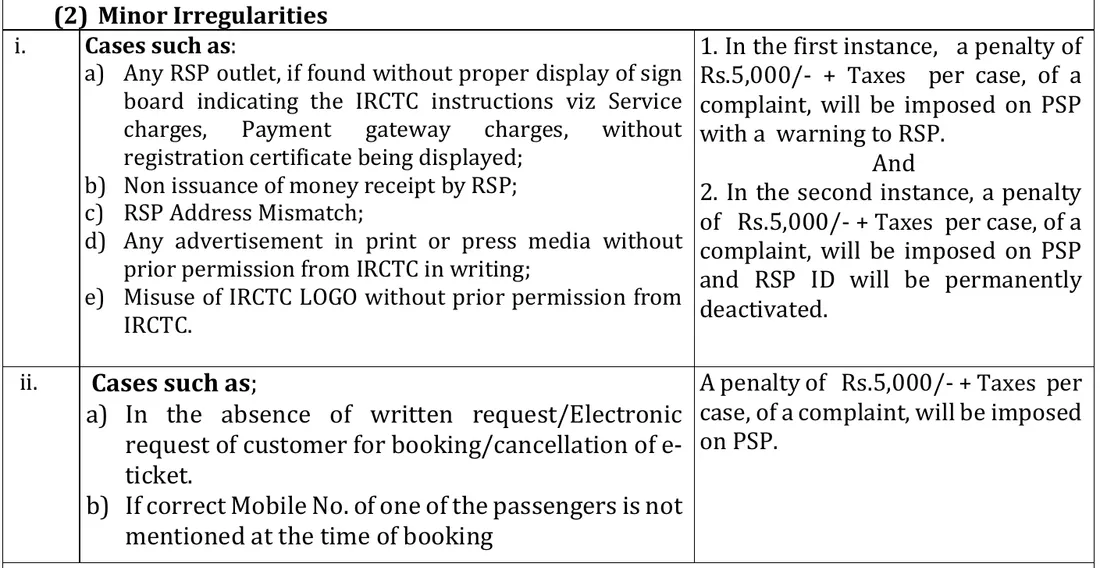
| Minor: outlet | No sign board or certificate, no money receipt, address mismatch, advertising or logo use without permission | ₹5,000 + taxes per case | 1st time: warning. 2nd time: permanently deactivated |
| Minor: records | No written or electronic request; wrong passenger mobile number | ₹5,000 + taxes per case | No ID action stated |
When complaints pile up against one PSP
| Proved complaints against different agents, in one month | Action on the PSP |
|---|---|
| 5 | Show cause notice |
| 6 to 10 | Suspended for 1 month |
| 11 to 15 | Suspended for 3 months; permanently deactivated if it happens twice |
| More than 20 | Suspended for 6 months; permanently deactivated if it happens twice |
IRCTC's table has no row for 16 to 20 complaints. A PSP gets 5 days to reply to a show cause notice and 3 days to pay a penalty, and IRCTC can terminate in the first or any instance.
When can't an agent follow the normal process?
| Situation | What to do |
|---|---|
| The customer will not give a written or electronic request, or an ID copy. | Do not book. You cannot keep the record IRCTC asks for. |
| The customer cannot share the cancellation OTP. | The refund is not processed without the correct OTP. Ask the passenger to receive it on the mobile on the ticket. |
| The Tatkal or opening-day agent block is still running. | Wait. Agents cannot book in the first 30 minutes of Tatkal or the first 10 minutes of opening-day general booking. |
| The customer wants a counter (PRS) ticket or an I-ticket. | You cannot sell one. Send the customer to a railway reservation counter. |
| Your agent ID is suspended or not working. | Do not use a personal ID or another agent's ID. Contact your PSP. |
| The customer cannot be paid a TDR refund. | Return the amount to IRCTC after 5 working days. Do not keep it. |
Important notes
- Written request: maintain written or electronic booking requests for every booking and cancellation.
- Which document applies: the agent rules PDF is the current rulebook (it is Annexure A of IRCTC's 2020 PSP policy). The 2013 rules and the 2019 agent policy are older; where they differ, the newer rules apply.
- Your PSP agreement can add duties of its own. Ask SiOnline if you are unsure.
Sources
All checked on 21 November 2026.
- IRCTC, Rules & Regulations for Reserved Rail e-Ticketing Service Providers (PSPs/RSPs). Clause references on this page are to this document.
- IRCTC, Policy for integration of Principal Service Providers, 2020 (w.e.f. 2 September 2020).
- IRCTC, Rules and Regulations (2013), older version.
- IRCTC, Revised Agent Policy (w.e.f. 29 November 2019), older version.
- IRCTC, Norms for Internet Cafe Scheme.
- IRCTC, Refund Rules and TDR Filing.
- IRCTC, Tatkal Ticket Booking Guide.
- PIB, Tatkal: Aadhaar authentication and agent restriction, 11 June 2025.
- PIB, Aadhaar authentication in the first 15 minutes of general reservation, 15 September 2025.
- PIB, Advance reservation period reduced to 60 days, 17 October 2024.
- PIB, Five new reforms under Reform Express, 24 March 2026.
- PIB, RailOne app and anti-fraud measures, 22 July 2026.
Questions agents ask about IRCTC rules.
Who is an RSP in IRCTC's rules?
RSP means Retail Service Provider, the word IRCTC's rules use for an agent. A Principal Service Provider (PSP) such as SiOnline registers the RSP with IRCTC, and IRCTC issues the agent ID for booking e-tickets only.
Can an IRCTC agent book tickets on a personal IRCTC ID?
No. IRCTC's rules say agents must book only on IRCTC-provided agent IDs. An agent found using a personal user ID for commercial gain has the ID deactivated immediately and faces punitive or legal action.
How long must an agent keep booking requests?
Six months. The written or electronic request and a copy of the customer's ID proof must be kept at the outlet for both bookings and cancellations, and shown to IRCTC when asked.
Who pays the penalty when an agent breaks the rules?
IRCTC imposes the money penalty on the PSP, from ₹5,000 + taxes up to ₹25 lakh + taxes per case. For the agent, the result is a warning or permanent deactivation of the agent ID, and criminal cases go to the Railway Protection Force (RPF).
When can agents book Tatkal tickets?
Not in the first 30 minutes. Tatkal opens at 10:00 AM for AC and 11:00 AM for non-AC, so agents can book AC from 10:30 AM and non-AC from 11:30 AM.
Can an agent charge for cancelling a ticket?
No. IRCTC's rules say there is no agent service charge for cancellation, and collecting any extra charge, for cancellation or for checking availability, is forbidden.
What signs must an IRCTC agent display?
A sign board outside the agency showing IRCTC rules, IRCTC service charges, agent service charges and payment gateway charges, and the Certificate of Authorisation from the PSP, displayed prominently.
Next steps
Questions about a rule at your counter?
SiOnline support is available 24 hours, 7 days on +91 91091 35959. Ask before you book, not after a complaint.